
Topic Menu
- Home
- News, research & events
- Current Projects
- Safer Roads
- Report a hazard
- Safer People
- Safer Equipment
- Safety Co-ordination
- References
- Sitemap

Fatigue
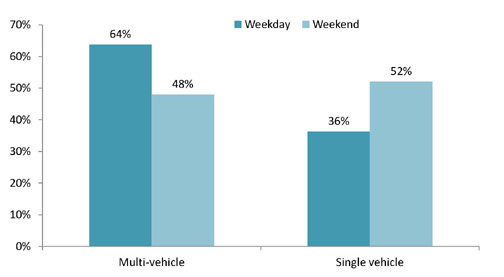
Motorcyclists are more likely to be involved in a crash on a weekend than on a weekday. Between 2006-10, 23% more motorcycle crashes including 47% of all fatal crashes occurred on a weekend rather than week day. Over 48% of fatal weekend crashes were single vehicle crashes.
The following graph compares the pattern of crashes on weekends and weekdays. The majority of weekend crashes involve only a single vehicle, where as collisions with other vehicles are more likely to occur during the week and be due to the other driver.
Driver fatigue is recognised as a major contributor to the NSW road toll, but the role of fatigue in motorcycle crashes has not been established. There is some ground for concern that as a result, the numbers of crashes involving rider fatigue are underestimated and riders are not sufficiently warned of the risks they take.
In the five years 2006-10, only 912 motorcycle crashes were classified as fatigue related. These crashes resulted in the deaths of 35 motorcyclists and 869 injured. Over all fatigue was associated with 7% of all motorcyle crashes but 24% of all fatal motorcycle crashes. This compares with 8% of all motorcycle crashes but 12% of all fatal crashes.
Rider survey data shows that large numbers of motorcycles are on the road across the weekend and that distances covered are often large. There are on average almost twice as many single vehicle crashes on weekend days as on weekdays (Odds ratio = 1.9). The concentration of single vehicle crashes on weekends, may indicate fatigue as an unrecognised factor in some of those crashes.
The criteria used by police to determine whether fatigue was a factor in a crash, describe fatigue as it affects drivers, which is quite different to the symptoms of fatigue in riders. RTA Definition of fatigue
Whereas a fatigued driver may drift across the road in a micro-sleep, a fatigued rider may be quite alert but crash on a curve or while overtaking due to an error of judgment. It may be that some motorcycle crashes that are assumed to be due to excessive speed, may in fact be the result of poor judgment and loss of attention due to fatigue.
Driver fatigue is a general term commonly used to describe the experience of being "sleepy", "tired" or "exhausted". Fatigue is both a physiological and a psychological experience. Driver fatigue can severely impair judgment and is particularly dangerous because one of the symptoms is decreased ability to judge our own level of tiredness. A range of typical symptoms are described by the RTA [RTA, Fatigue: Fatigue Problem Definition and Countermeasures Summary, 2001].
They include:
- loss of concentration
- drowsiness, yawning
- slow reactions
- sore or tired eyes
- boredom
- feeling irritable and restless
- making fewer and larger steering corrections
- missing road signs
- having difficulty in staying in the lane
- having microsleeps.
These are predominantly the symptoms of performing a monotonous task within an enclosed vehicle, where the operator is separated from the external driving environment. In a modern car with a large fuel tank, a driver could continue without a break for many hours.
Driver reviver programs focus on the value of encouraging drivers to stop for a break and revive every two hours, but this may be a less appropriate countermeasure for motorcyclists.
The two hour time frame is based on fatigue as it affects a driver. Motorcyclist are unlikely to ride for more than about two hours without a break because they will run out of fuel. This does not mean that motorcyclists do not suffer from fatigue, but the symptoms and time frames may be different.
Riding a motorcycle is far more physically and mentally demanding than driving a car. Rider fatigue is more likely to be a response to physical exhaustion than to monotony. Other factors include dehydration and exposure to the weather (heat, cold, wind noise and buffeting etc). The symptoms of rider fatigue include:
- joint and muscle stiffness
- pain or weakness in hands and feet
- loss of concentration
- slow or impaired judgment and reactions.
There is an urgent need to research the causes and symptoms of motorcyclist fatigue and develop new criteria to be applied by police when reporting motorcycle crashes. This may clarify the relevance of fatigue as a factor in crashes and encourage the development of appropriate rider fatigue countermeasures.
What can you do to avoid fatigue?
Strategies and exercises to help maintain circulation and keep you alert.
- Make regular stops to walk around and stretch. This should be at least every hour and a half (RTA, 2003).
- Set realistic targets for trips. Work out the distance and your estimated speed and then double the time required to allow for rest breaks and to take the pressure off. Enjoy the ride.
- Drink lots of water. Dehydration is a serious problem for riders because you are so exposed to sun and wind.
- Avoid coffee and soft drinks, they provide only a short term lift and then leave you more fatigued.
- Avoid alcohol. Alcohol is a depressant and even small amounts can increase the risk of a fatigue crash.
- Eat light snacks frequently, rather than heavy meals. Digestion takes energy, which is why one feels sleepy after a heavy meal.
When riding and it is safe and the road is clear, try little exercises to keep you circulation moving.
- Put your weight on the footpegs and lift your body off the seat.
- Wiggle your toes.
- Shrug and rotate your shoulders.
RTA Definition of fatigue
Fatigue in road crashes
Fatigue is considered to have been involved as a contributing factor to a road traffic accident if that accident involved at least one fatigued motor vehicle controller.
A motor vehicle controller is assessed as having been fatigued if the conditions described under (a) or (b) are satisfied together or separately.
(a) The vehicle’s controller was described by police as being asleep, drowsy or fatigued.
(b) The vehicle performed a manoeuvre, which suggested loss of concentration of the controller due to fatigue, that is:
- the vehicle traveled onto the incorrect side of a straight road and was involved in a head-on collision (and was not overtaking another vehicle and no other relevant factor was identified); or
- the vehicle ran off a straight road or off the road to the outside of a curve and the vehicle was not directly identified as travelling at excessive speed and there was no other relevant factor identified for the manoeuvre.
- 1. File description: Fatigue_Report [723.2KB]
-
File name: Report.pdf