Topic Menu
- Home
- News, research & events
- Current Projects
- Safer Roads
- Report a hazard
- Safer People
- Safer Equipment
- Safety Co-ordination
- References
- Sitemap

What parts of your body should you protect?
| Which parts of your body are most at risk in a crash? | |
|---|---|


|
Please click on each body area for more information.

|
Riders wearing gloves are 50% less likely to injure their hands (Hurt et al, 1981).
Most riders do wear gloves.
Make sure they will protect you when it matters,when you are sliding down the road on your hands and knees.
Keeping your hands warm and dry is also important for your safety.
Before you buy some gloves read the section on Protection from the weather and the section on choosing gloves Gloves.
Broken wrists are relatively rare (2%)
One in ten rider casualties have cuts and abrasions to their wrist (10%). Either they were not wearing gloves, the gloves came off or the gloves were too short.
Gloves should come at least 50mm over your wrists and be fastened so that they cannot be pulled off.
See the section What to look for when buying motorcycle gloves Gloves.
Riders with motorcycle boots are 50% less likely to injure their feet (Hurt, 1981).
Your feet are the part of your body most likely to contact the road in a crash. You need impact protection for the ankle and heel, but as the statistic above illustrate, you are more likely to tear ligaments, skin and muscle than break bones in your feet.
How long would your boots stay intact if they were dragged along the road?
Would the soles protect you or just peel off exposing your feet to the road?
See the section on what to look for when buying motorcycle boots Boots.
Almost one in four rider casualties injure their ankles (23%).
Two out every three riders with ankle or foot injuries were not wearing motorcycle boots (Hurt, 1981). Fractured ankles are relatively rare but are more likely to be caused through an impact with a car than from hitting the road (Otte et al, 2002).
See the section on what to look for when buying motorcycle boots Boots.
Legs are the part of your body most likely to be injured but are least likely to be protected (de Rome et al, 2002).
Eight out of ten rider casualties have leg injuries and three of these will have fractures. Fractures are more likely to be from an impact with a car than from hitting the road (Otte, 2002).
It is when you hit the road that protective clothing is the most help. It can prevent or reduce the cuts, abrasions and serious skin and muscle loss from sliding across a road surface.
Wear impact protectors over your knees and shins. They may not prevent a fracture, but you will be more likely to have a simple closed fracture which is easier to treat than a complex fracture (Otte, 2002).
See the section on what to look for when buying motorcycle jackets and pants Jackets and pants.
The lower leg is the part of the body most likely to break.
Impact protectors may not prevent a fracture, but you will be more likely to have a simple closed fracture which is easier to treat than a complex fracture (Otte, 2002).
See the section on what to look for when buying motorcycle jackets and pants Jackets and pants.
See the section on choosing impact protectors Impact protectors.
Half of all injured riders hurt their knees.
Most knee injuries involve soft tissue damage, usually from contact with the road. This ranges from loss of skin through to dislocation and ligament damage, but rarely fractures.
These are the types of injury where abrasion and impact protection can really help.
See the section on choosing impact protectors Impact protectors.
Denim jeans will last less than one second when you hit the road (SATRA, 2002).
More than one in ten rider casualties have broken their thigh bone (13%).
There is a point at which nothing can protect you from an impact with another object at speed, but good protective clothing can reduce some of the injuries and prevent contamination of wounds.
Impact protectors may not prevent a fracture, but you will be more likely to have a simple closed fracture which is easier to treat than a complex fracture (Otte, 2002).
See the section on choosing jackets and pants Jackets and pants.
More than one in ten rider casualties (13%) injure their pelvis or hips.
Almost half of those riders with pelvic injuries will have internal injury to organs (6%).
Injuries to the pelvis are more likely to be due to impact with an other object, but can also be caused by hitting the road (Otte, 2002).
Impact protectors for the hips are required under the European Standard for motorcycle protective clothing. Make sure they are marked EN 1621-1.
Use the diagram on injury zones to make sure you protect the right parts of your body. See the section on impact protectors Impact protectors and what to look for when buying motorcycle jackets and pants Jackets and pants.
The data shows that more than one in five rider casualties (22%) will have injured their forearm, but it is more likely to be soft tissue damage (15%) than a break (9%).
Cover your arms with abrasion resistant material. Make sure your jacket is fastened at the wrists and cannot ride up exposing your skin to the road.
See the section on what to look for when buying motorcycle jackets and pants. Jackets and pants.
You are more likely to damage skin and muscle than to break your upper arm.
Cover your arms with abrasion resistant material. Use the diagram on injury zones to make sure you protect the right parts of your body. See the section on what to look for when buying motorcycle jackets and pants Jackets and pants.
A chipped elbow can cause long term problems that are worse than a simple broken arm.
Make sure your jacket has impact protectors that comply with the European Standard (they must be marked EN 1621-1), that they are the correct size for your body (they come in two sizes A and B) and they are fitted to stay in place.
Use the diagram on injury zones to make sure you protect the right parts of your body. See the section on what to look for when buying jackets and pants Jackets and pants and the section on impact protectors Impact protectors.
More than half of all rider casualties have arm injuries.
Most riders wear motorcycle jackets and yet over half suffer soft tissue damage in crashes.
What happened to these riders? Did their jacket come off or did it tear? Was it the rider's fault for not having it properly fastened or did the jacket fail to live up to expectations?
See the section on what to look for when buying motorcycle jackets and pants Jackets and pants.
Internal injuries to organs are relatively rare (7%) but can be very serious.
There is a point at which nothing can save you from an impact with another object such as a car or pole. The only protection is avoidance.
Chest injuries can include internal injuries although these are relatively rare (7%).
Chest injuries are most likely to be caused in an impact with another vehicle (Otte, 2002).
There is a point at which nothing can save you from the impact with another object. The only protection is avoidance.
However keeping your body comfortable and protected from the weather is also important for your safety. Read the section on Protection from the weather and the section on what to look for when buying motorcycle jackets and pants Jackets and pants.
One in five rider casualties have shoulder injuries.
These injuries are more likely to involve soft tissue damage, but almost half of all shoulder injuries involves a fracture. This is why the European Standard requires impact protectors for the shoulders.
Check that your jacket has impact protectors that comply with the European Standard (they must be marked EN 1621-1) and that they are the correct size for your body (they come in two sizes A and B).
See the section on what to look for when buying motorcycle jackets and pants Jackets and pants and on impact protectors Impact protectors.
Neck injury affects almost one in ten rider casualties (9%).
Over eighty percent of riders with head injuries, were either not wearing a helmet or it came off (Hurt, 1981).
Almost one in three riders with head injuries (30%) have brain damage (Otte et al, 2002).
There is no point in wearing a helmet if it is not securely fastened.
See the section on choosing and caring for your helmet Helmets.
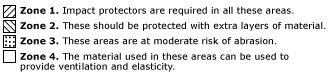
Note: The injury data used in this figure is based on Otte & Middlehavre, (1987) and was confirmed as typical of the pattern of injury in motorcycle crashes by the European Experimental Vehicles Committee (EEVC,1993). The risk zones figure is taken from Woods, 1996.